








Expedited Shipping: What Small Businesses Need To Know Before Promising Fast Delivery
25 May 2026
6 Mins Read
- What Is Expedited Shipping?
- Expedited VS. Standard VS. Express: A Quick Breakdown
- Why Small Businesses Can't Ignore This?
- Case Study Analysis
- Which Carriers Offer Expedited Shipping?
- How Much Does Expedited Shipping Cost? And Who Pays?
- Pass It Entirely To The Customer.
- Split The Cost.
- Offer It For Free Above A Threshold.
- The Fulfillment Side: What Actually Makes Expedited Shipping Work?
- A Note On Margins
My sister and I started a small online bakery shop out of her kitchen in Austin. This blog is about her. In the starting days, the business was fine.
None of us had big expectations from it. However, the average number of orders that dropped was enough.
But after some days, one of our neighbors started the same business. No wonder she stole my sister’s idea and copied it. But that’s not my point here.
The other business was selling identical products. Meanwhile, the prices were similar too. To sum up, the products were comparable.
So, what was the reason for my sister losing customers? That competitor offered two-day shipping. She didn’t have that.
Later, I found that many US-based small businesses face this problem. Expedited shipping has quietly become one of the biggest competitive battlegrounds in ecommerce today. Sadly, small businesses are often the last to adapt.
What Is Expedited Shipping?
Put simply, expedited shipping gets a package to the customer faster than the standard option. That’s it. There’s no universal definition.
USPS follows one formula for expedited shipping. While FedEx calls something else expedited. What’s fast for your small business might be just the baseline for Amazon.
For most domestic US shipments, expedited delivery is typically overnight to two-day service. To clarify, this is the procedure that most businesses follow for expedited shipping.
The expedited trucks move directly from pickup to destination with no intermediate stops. Meanwhile, the standard shipments bounce through multiple sorting hubs, which is what slows them down. However, during expedited shipping, the package skips most of that procedure.
In a regular ecommerce fulfillment setup, an order goes from the warehouse to a last mile sorting and distribution center. After that, it goes out for final delivery. But when you choose expedited shipping, you can skip many steps of that chain.
Expedited VS. Standard VS. Express: A Quick Breakdown
If you want to set your shipping and logistics as a benchmark for your business, you need to know about these 3 shipment standards:
| Shipping Type | Typical Delivery Time (Domestic US) | Relative Cost |
| Standard | 3 to 7 business days | Lowest |
| Expedited | 1–3 business days | Moderate to High |
| Express / Overnight | Next day or same day | Highest |
Do you know about an important area where most small business owners feel confused? Simply put, most carriers calculate shipping time from the time the order ships, not from when the customer places it.
So if someone orders Thursday night and you ship Friday, the “2-day shipping” window means your customer gets the order next Wednesday. But why? Here you have to factor out the weekend.
If you’re wondering how long does Amazon take to deliver, the honest answer is one to two days for Prime members in most metro areas. That’s the benchmark your customers carry in their heads when they shop from your store.
Why Small Businesses Can’t Ignore This?
A few years ago, a two-day delivery promise was a nice perk. Now it’s a compulsory benchmark. Customers have been trained by Amazon. They expect a 2-day delivery to be basic.
The cost of not offering fast shipping isn’t just lost sales at checkout. When you display a 3- to 5-day delivery schedule, you experience a high rate of cart abandonment.
Studies from the Baymard Institute have found that nearly half of US online shoppers who abandon a cart do so because of unsatisfactory delivery options or costs. That’s a staggering leak in any small business’s funnel.
Case Study Analysis
Cara Bennet ran a Shopify store selling handmade jewelry. She told me she hadn’t changed her shipping options for two years because they felt complicated.
When she finally added a $12.99 expedited option at checkout, her conversion rate for orders over $60 increased noticeably within 60 days.
What’s noticeable is that she didn’t change her products. Nor did she run new ads. She just gave people a fast option they could trust.
That’s the small business angle that small businesses often miss. It’s not about logistics at scale. On the contrary, it’s about incorporating the features that make more customers checkout your brand.
Which Carriers Offer Expedited Shipping?
The three major domestic carriers each have their own version of fast expedited shipping. Here’s what differentiates them:
| Carrier | Expedited Service | Transit Time | Starting Price (approx.) |
| USPS | Priority Mail Express | 1–2 days | ~$31.40 |
| UPS | UPS 2nd Day Air | 2 business days | Varies by weight/zone |
| FedEx | FedEx 2Day | 2 business days | Varies by weight/zone |
USPS Priority Mail Express is genuinely fast and offers a fixed price, making it more predictable for small sellers.
Meanwhile, UPS and FedEx pricing fluctuates, based on dimensional weight and delivery zones. Therefore, keep in mind that the actual costs can surprise you.
There’s another thing worth knowing. If you’re a small seller trying to keep shipping costs down without locking into a major carrier, Sendle USA can be a good option.
In fact, I used the platform for 2 years. They focus on small-business parcel shipping with flat-rate domestic pricing. For me, that predictability made cost planning easier.
How Much Does Expedited Shipping Cost? And Who Pays?
This is where most small business owners freeze. They see the carrier rate, which is $25, $35, or sometimes more.
Meanwhile, they assume they have to bear it. If they pass it on to the customer, it will result in cart abandonment. But that is not always the case.
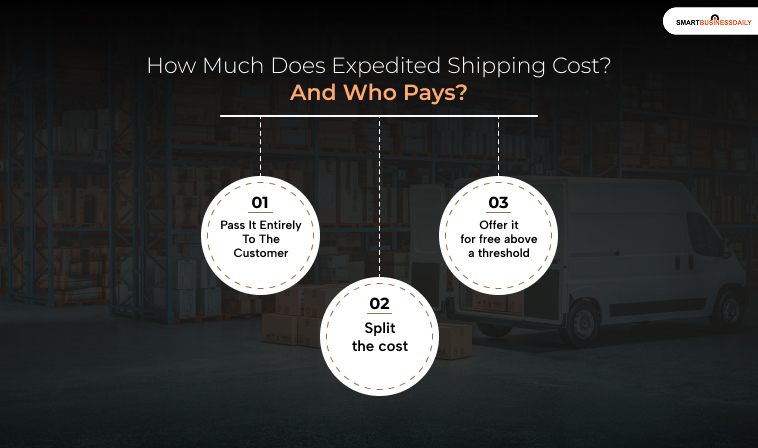
As a small business, you can follow any of these 3 models:
Pass It Entirely To The Customer.
Offer it as a paid upgrade at checkout. Most customers who need fast delivery will pay. A Capital One survey found that 41% of US consumers are willing to pay more for same-day delivery on important purchases.
Split The Cost.
Charge a flat expedited fee (say, $9.99) and absorb the difference. For high-margin products, this math often works in your favor by helping you prevent abandoned carts.
Offer It For Free Above A Threshold.
Free expedited shipping on orders over $75 can increase average order value. However, it will offset your shipping cost.
The worst approach is to offer expedited shipping but price it so high that customers never select it. This is one thing that you have to positively keep in mind as a small business.
You May Also Like: Last Mile Delivery: The Final 50 Feet That Make or Break Your Business
The Fulfillment Side: What Actually Makes Expedited Shipping Work?
Offering fast shipping on your website is one thing. But actually offering the same against every order is a different thing.
This is where many small businesses fail. They promise two-day shipping, then spend a full day processing the order before it even reaches a carrier.
By the time the package reaches a carrier for last-mile delivery optimization, you’ve already burned half your time window.
To fix that, you need a faster internal process. For example, you can try same-day order cut-offs. At the same time, my friend suggested me to try pre-packed SKUs for my bestsellers.
While trying that, I got another idea. I tried batch printing labels before I started packing. These aren’t complicated changes, but they require discipline.
Some sellers at the mid-growth stage use AI route optimization tools to batch and prioritize orders. In other words, you are simply letting software decide which packages go with which carrier and route based on speed and cost.
It’s not just for big warehouses anymore. In fact, there are plenty of lightweight tools built for ecommerce fulfillment that can help even solo operators.
And when something goes wrong, you need a clear process. Respond the same day. Again, reship if possible. Don’t make the customer chase the carrier. That’s the crux of building good customer relationships and getting more repeat orders.
A Note On Margins
Expedited shipping can eat your margins if you’re not careful. But that doesn’t mean you will completely avoid it. Instead, you can offer it strategically.
The first strategy is offering expedited shipping selectively. I mean, offer it only on products where your margin can absorb a partial subsidy.
Simply put, use it as a loyalty perk. Raise your free shipping threshold on standard delivery to push more customers toward a paid fast option.
Small businesses that treat shipping as a tactic, not just a logistics cost, tend to use it to their advantage. Remember my sister’s bakery shop in Austin?
We now offer free standard shipping on all orders. But our expedited option funds itself because it converts into high-margin bundles. As a result, we can easily afford expedited shipping.
That’s the mindset shift. Shipping speed isn’t a cost-incurring thing anymore. For small businesses willing to treat it like a sales tool, it’s actually one of the cheapest ways to compete.
Have questions about shipping tools or small business logistics? Drop a comment or reach out through the contact page at smartbusinessdaily.com.




Related Articles
Comments Are Closed For This Article